
Bothell Previous Residents by Era
Begin with the age of the question. Current parcel reports establish the land identity and present owner, while deeds move ownership backward. Printed reverse directories and newspapers are better evidence for occupants. Census schedules can identify whole households, but released federal schedules stop at 1950 because of the 72-year rule. Building permits and Sanborn maps describe changes to the structure, not necessarily the people inside it.
| Source | Time span | Custodian | Useful evidence |
|---|---|---|---|
| King recorded deeds | Most online from August 1, 1991 | King County Recorder and Archives | Grantors, grantees, dates, parcel and legal text |
| Snohomish recorded deeds | Most online from July 1976 | Snohomish County Auditor Recording | Transfers, plats, liens and instrument images |
| Polk North Suburban directory | Early 1970s lead, exact volume must be checked | KCLS, Bellevue in-library use | Address-to-name clues and nearby entries |
| Bothell and Northshore newspapers | 1908-1960 digitized runs | KCLS and local historical groups | Obituaries, notices, relatives and events |
| Federal census schedules | Released through 1950 | State Library and genealogy databases | Household members and relationships |
| Sanborn maps | 1912, 1926 and 1932 downtown sheets | KCLS licensed collection | Footprint, use, materials and street context |
For a recent transfer, start with the matching county recorder. For an early twentieth-century household, use the deed only as the ownership frame, then test names in a directory, census, or newspaper. No negative online result proves that nobody was there. It may only mean that the record predates digitization or sits under an older place name.
Fix the Bothell Parcel First
A street address is a weak bridge across decades. Search the address in the King County Parcel Viewer or Snohomish SCOPI, based on the city and county map. Save the parcel ID, legal description, situs address, current owner, and tax mailing address. Situs means the physical property address; the tax mailing address may lead elsewhere.
Bothell annexed Canyon Park in 1992 and remaining King County potential-annexation areas in 2014. Older material may place the same land in a township, precinct, unincorporated area, or nearby community. When the old number fails, the legal description, subdivision, lot, block, and cross streets can reconnect it.
Note: No official source reviewed confirms one citywide Bothell street-renumbering year, so do not force a modern number into an older source.
Bothell Deed Cutoffs Matter
The county line changes the search. King County Landmark covers most recorded documents from August 1, 1991. Its parcel route generally reaches 1997 to the present, while name, legal-description, recording-number, and book/page modes can reach farther. King images are viewable in the browser, but certified and uncertified copies use the account and cart workflow.
Snohomish Recorded Documents covers most instruments since July 1976. A free account is required as of March 2, 2026. Earlier Snohomish work moves to public terminals and microfilm in Everett, with staff research or a written copy request as alternatives. Earlier King work moves to King County Archives and microfilm in Seattle. Those two fallback paths are not interchangeable.
That split is a useful number story: the web can shorten a search, but it does not define the age of the county record. An old deed may be available even when the portal returns nothing.
Trace Bothell Owners Backward
A chain of title is the linked series of transfers for the same land. Work from a known present fact toward an older one. Names alone are not enough because common names, trusts, estates, and business entities can appear in the index. Match the legal description and recording details at every turn.
- Pull the present owner, parcel number, and legal description from the correct assessor report.
- Search that owner as grantee, the person receiving property, and locate the purchase deed.
- Record the grantor, or seller, plus the recording number, date, and matching land description.
- Search that seller as an earlier grantee. Repeat the loop while the parcel and legal text match.
- At the online cutoff, take the last firm name and date to the county archive, terminal, microfilm, or deed book.
- Grantor
- The party transferring an interest in land.
- Grantee
- The party receiving that interest.
- Chain of title
- The ordered link of recorded transfers for one property.
- Legal description
- Land text based on lots, blocks, plats, or survey calls. It can outlast a street number.
A deed shows an ownership transfer, not a complete list of previous residents. A buyer might rent the house, live elsewhere, or hold it through an estate or trust. Occupancy needs a second source.
Bothell Previous Residents in Polk
KCLS identifies an early-1970s Polk Seattle North Suburban directory as an in-library resource at the Bellevue branch. It is a reverse-address lead rather than a verified continuous Bothell run, so call ahead and confirm the exact volume and year. Search the street section for the old address, capture the printed name, and then check that name in the alphabetical section.
A criss-cross directory is arranged by address or phone number instead of only by surname. It may name an occupant even when that person did not own the parcel. Survey timing, abbreviations, omissions, and moves can make an entry stale, so compare the years on each side and check the directory key. The Bothell city directory page explains the collections and entry format in depth.
Note: Search regional titles such as Seattle North Suburban and Northshore, because the local volume may not carry Bothell in its main title.
Maps Date Bothell Buildings
KCLS points to Bothell downtown Sanborn fire-insurance sheets for 1912, 1926, and 1932. Compare footprint, street label, lot line, construction material, and use across the three dates. The map can show when a structure appeared or changed, but it cannot name previous residents. Pair it with a directory entry, deed, permit, or newspaper item.
The distinction matters in Bothell. Hannan House was moved from Main Street to Bothell Landing in 1978. Its building history and its parcel history therefore split. Historical photographs and museum files can follow the building, while recorder and assessor records follow the land.
The KCLS Bothell History list also points to house photos and local books. Puget Sound Regional Archives may have pre-1972 King County house photographs, if a photo was made. Availability is not guaranteed.
Bothell Names in Early Deeds
The Bothell Historical Museum Society document collection offers an unusually direct local land story. The State Archives inventory describes deeds, bills of sale, and title abstracts for David and Albert Bothell dated 1872 through 1921, plus papers from area businesses, churches, and people. This is a collection lead, not an online resident index.
Contact the Bothell Historical Museum resources desk or use the State Archives catalog to ask about the exact folder. Cite the collection title and date range in the request. The museum is at Hannan House in Bothell Landing and holds other photographs and legal papers that may explain a name found in the deed trail.
The museum resources page introduces the surviving local sources.
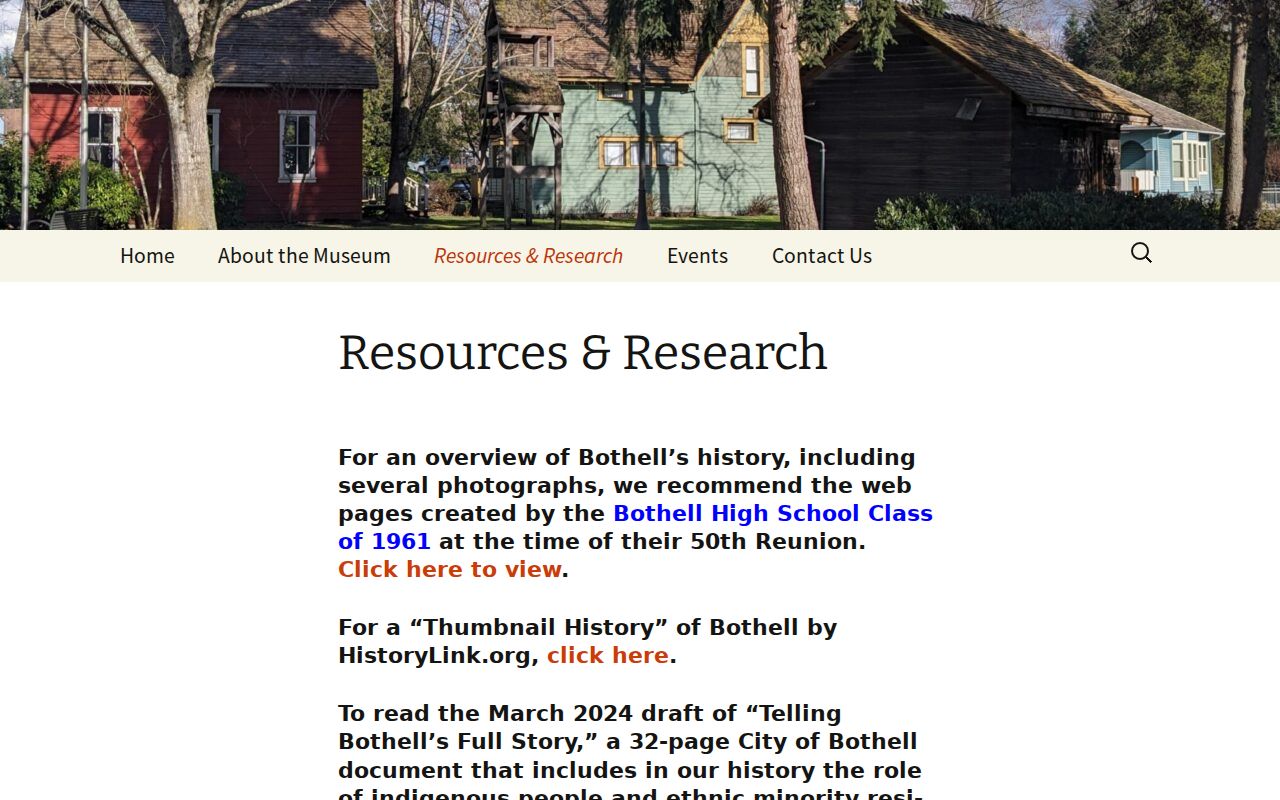
The captured page is a starting point for an archive question, not proof that a specific family lived at an address.
Link Bothell Households Across Records
Directories can place named occupants between census years. Federal schedules add family relationships and household members, but geography may be indexed under a county, township, precinct, or nearby community rather than modern Bothell. Newspapers then extend the trail through obituaries, legal notices, civic events, business notices, and relatives.
- Transcribe the address and every name from the closest directory year.
- Find the nearest released census and match county, household names, ages, and neighbors.
- Check the prior and next directory year to bracket a move.
- Search Bothell and Northshore newspapers with the surname, old street, church, business, or event.
- For a death or transfer by estate, ask the proper superior-court clerk or archive for probate.
Bothell and Northshore Citizen runs from 1908 through 1960 are split between local digitization projects. KCLS can help route access. Probate may identify an executor, heirs, and property references, but restricted material remains with the court.
Lawful use. Research Bothell previous residents for house history, genealogy, estates, or personal curiosity. Never use a record to track, harass, or expose a living person.
Bothell Permits and Probate Clues
Building permits can date construction, additions, remodels, and changes of use. Ask the City of Bothell for permit history by address and parcel. Older files may require staff research rather than a portal search. A permit can name an owner, applicant, contractor, or contact in its public portion, but that name is not automatic proof of residence. Utility hookups were not documented as an open resident index and should not be treated as one.
When a deed trail ends with an estate, probate may supply the next link. King County historical probate files are held across the Superior Court Clerk and regional archives according to year, while Snohomish files route through its clerk and court systems. Ask with the deceased person's full name, an estimated death date, and the property reference. An available file may name an executor, heirs, or land, subject to restrictions and redaction.
Records that are not indexed online can be requested from the actual custodian. Under RCW 42.56.520, a Washington agency generally responds within five business days by supplying the record or link, acknowledging the request with an estimate, or denying it with a legal basis. That response rule does not open sealed court files or other exempt material. Be precise: identify the address, parcel, record type, and date span, and ask for an electronic copy when available.